The Complexity Paradox: Judy’s Story
There’s a special kind of irony in software development that only becomes apparent after years in the trenches: we start simple because we don’t know how to be complex, then become complex because we don’t know how to be simple again.
This is the story of Judy, a developer whose journey through the wilderness of code complexity mirrors what so many of us experience. It’s a tale of hubris, heartbreak, and ultimately, homecoming—to a simplicity that’s entirely different from where she began.
Act I: The Innocent Simplicity of the Beginner’s Mind
Fresh-faced and bright-eyed, Judy’s fingers danced across her keyboard on her first day as a junior developer. Each keystroke felt like magic—raw, unrefined, but magic nonetheless. The code she wrote was brutally straightforward:
“Make button do thing. Thing happens. Ship it!”
Her approach was refreshingly unsophisticated. Problems appeared, and she knocked them down one by one with whatever tools she had at hand. No architectural designs, no abstract factories, no dependency injection—just good old-fashioned imperative code that did exactly what it needed to do, nothing more.
“I remember celebrating when my form validation worked,” Judy recalls with a laugh. “It was 200 lines of nested if-statements, and I thought it was a masterpiece.”
Her code wasn’t elegant by experienced standards—it lacked abstractions and consisted mostly of sequential operations—but it had one undeniable virtue: it was easy to understand. You could trace through it line by line and see exactly what was happening.
Act II: The Intoxication of Knowledge
Three years into her career, Judy discovered design patterns, architectural principles, and the seductive allure of “best practices.” She dove headfirst into books on Clean Code, SOLID principles, and domain-driven design.
“I felt like I had been coding in the dark, and someone finally turned on the lights,” she says. “Suddenly, I saw patterns everywhere. Every problem became an opportunity to apply some sophisticated solution I’d just learned.”
What followed was a transformation. The junior developer who once wrote naive but functional code was now crafting intricate systems of classes, interfaces, and abstractions. Her colleagues nodded approvingly at her class diagrams and praised her architectural vision.
But somewhere along this journey, something shifted. What began as learning turned into showing off. Each pull request became a canvas for demonstrating her expanding toolkit—regardless of whether the situation called for it.
Consider this real example from her “complexity peak”:
// What started as a simple config loader...
class AbstractConfigurationManagerFactory {
createConfigurationManager(strategy, environment, cachePolicy) {
return new ConfigurationManagerImpl(
this.createLoadingStrategy(strategy),
this.createEnvironmentHandler(environment),
this.createCachePolicyEnforcer(cachePolicy)
);
}
createLoadingStrategy(strategy) {
switch (strategy) {
case "JSON":
return new JSONLoadingStrategyWithValidation();
case "XML":
return new XMLLoadingStrategyWithNamespaceSupport();
case "YAML":
return new YAMLLoadingStrategyWithSchemaValidation();
default:
throw new UnsupportedStrategyException(strategy);
}
}
// ...and it goes on for 200 more lines
}
When all she really needed was:
function loadConfig(filename) {
const content = readFile(filename);
return JSON.parse(content);
}
Act III: The Complexity Crisis
The warning signs appeared gradually. First, it was the bugs that took days to track down. Then came the new team members who needed weeks to understand her “elegant” architecture. The final straw was the analytics dashboard project—her magnum opus of overengineering.
“I built this real-time dashboard with every pattern I knew,” Judy recalls with a wince. “It had observers, factories, proxies, decorators—you name it. The architecture diagram looked like a space shuttle schematic.”
The result? A system that took three times longer to build than estimated, was nearly impossible to debug, and performed horribly under load. Worst of all, adding new features—the very flexibility all those abstractions were supposed to enable—became a nightmare.
Then came the moment of truth: a senior architect reviewed her code and asked a simple question that would change everything.
“What problem are all these abstractions solving?”
Judy had no good answer.
Act IV: The Enlightened Return to Simplicity
The realization didn’t happen overnight. It began with small refactors—replacing complex inheritance hierarchies with simple functions, eliminating unnecessary indirection, and being more judicious about abstractions.
“I started approaching each problem with a new question,” says Judy. “‘What’s the simplest thing that could possibly work?’ And I wasn’t allowed to add complexity until I had a compelling reason.”
Gradually, her code changed. It became shorter, more focused, and paradoxically, more powerful. She discovered that true mastery wasn’t about showing how much you know—it was about delivering maximum value with minimum complexity.
// The evolved approach
function getConfiguration(source) {
const loaders = {
json: file => JSON.parse(readFile(file)),
yaml: file => parseYAML(readFile(file)),
// Add more when (and only when) needed
};
const extension = source.split(".").pop();
const loader = loaders[extension] || loaders.json;
return loader(source);
}
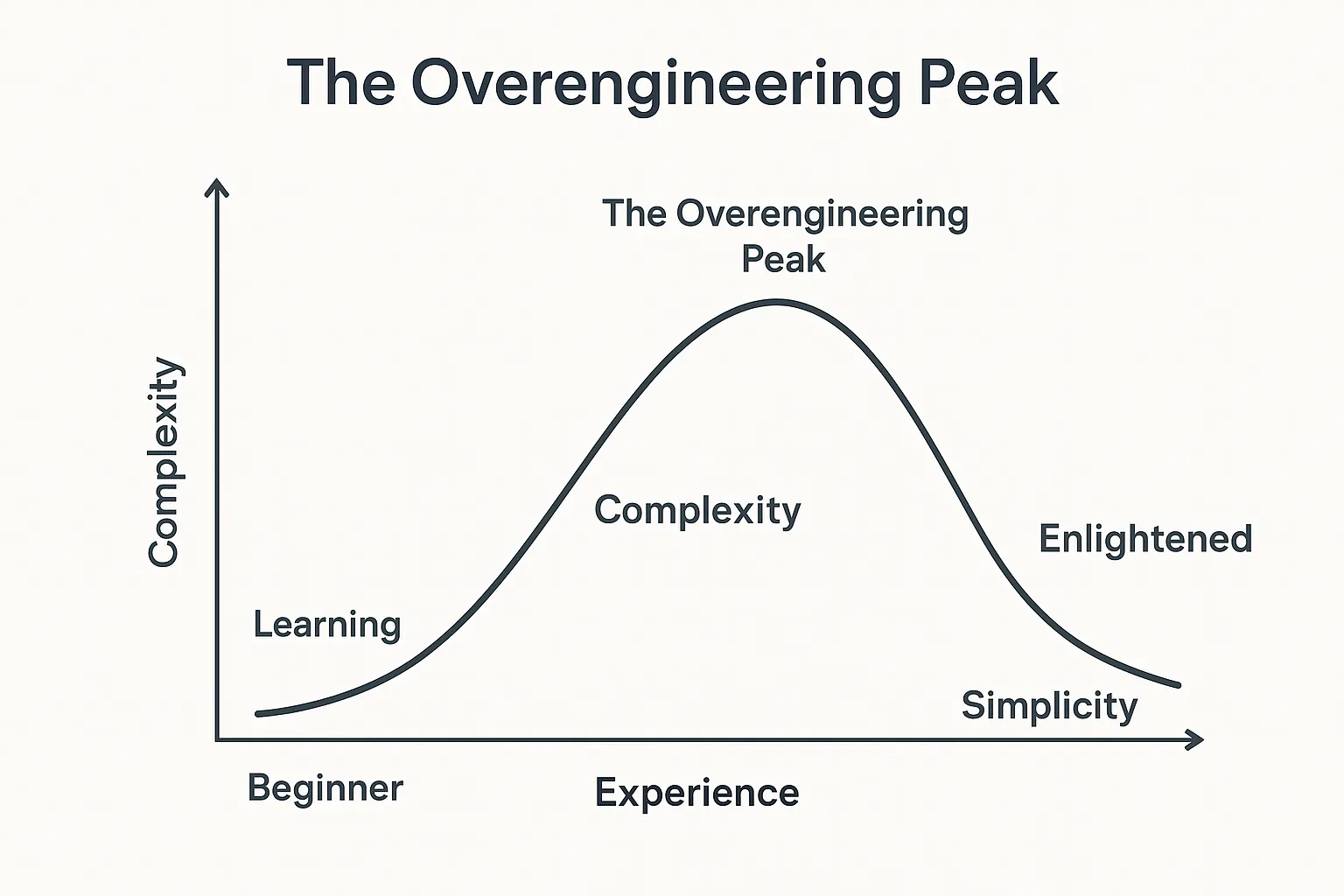
The arc of Judy’s developer journey looked something like this:
Why We Fall Into The Complexity Trap
Judy’s story isn’t unique. The overengineering phase is almost a rite of passage for developers. But why does it happen?
-
Intellectual Validation: Complex solutions make us feel smart. They’re our way of proving we understand sophisticated concepts.
-
Career Advancement: Many organizations unconsciously reward complexity, mistaking it for sophistication.
-
Fear of Future Requirements: We overdesign to accommodate changes that may never come.
-
Resume-Driven Development: Learning new frameworks and techniques by applying them whether needed or not.
-
The Curse of Knowledge: Once you know about a pattern or technique, it’s hard not to see opportunities to use it everywhere.
The Wisdom of Simplicity: Lessons from the Other Side
Now a principal engineer leading a team of 15 developers, Judy has distilled her experience into principles she shares with every new hire:
1. Solve the Problem First, Then Improve the Solution
Write the simplest code that solves the actual problem before thinking about extensibility or elegance. Get something working, then refine.
2. Complexity Is a Cost, Not a Feature
Every layer of abstraction, every design pattern, every “just in case” feature comes with a maintenance cost. Be sure the benefit justifies this expense.
3. Embrace the “Rule of Three”
Don’t abstract until you’ve written similar code at least three times. Premature abstraction is just as dangerous as premature optimization.
4. Your Future Self Has Better Information
Design only for requirements you have now, not the ones you imagine. Your future self will have better information about what’s actually needed.
5. Code Is Communication
Remember that your primary audience is other humans (including your future self), not the computer. Optimize for readability and clarity above all.
6. The Best Code Is No Code
The most reliable, efficient, and maintainable code is code you don’t have to write. Solve problems by removing complexity, not adding it.
7. Beware the Siren Song of Frameworks
Choose the minimum viable technology that solves your problem. The “coolness factor” of new tools fades; the maintenance burden doesn’t.
The Signs You’re Overengineering
How do you know if you’re in the complexity trap? Watch for these red flags:
- Excessive Layers - If you can’t explain your solution’s flow in a few sentences
- Premature Flexibility - Building for scenarios that don’t exist yet
- Configuration Explosion - When setting up requires pages of documentation
- Debugging Dread - When issues are hard to trace through your layers of abstraction
- Onboarding Overwhelm - New team members take weeks to understand the system
- Feature Friction - Simple changes require modifying multiple parts of the system
The Journey Home
“The irony is that I’ve come full circle,” Judy reflects. “I’m writing simple code again, but it’s a completely different kind of simplicity. It’s not simple because I don’t know any better—it’s simple because I know too much not to value simplicity.”
That’s the true developer lifecycle: from naive simplicity through complexity and finally to enlightened simplicity. It’s a journey from writing simple code because that’s all you know, to writing simple code because that’s what you know works best.
And that final stage—the enlightened return to simplicity—is where the true masters of the craft reside.
FAQ: Navigating Development Complexity
Q: How do I recognize when I’m overengineering a solution?
A: Ask yourself: “Could I explain this solution to a new team member in under 5 minutes?” If not, you might be overcomplicating things.
Q: What’s the difference between good architecture and overengineering?
A: Good architecture solves actual, not imagined, problems. It makes the system easier to understand, not more impressive-looking.
Q: How do I balance simplicity with planning for the future?
A: Build for what you know, and make peace with the fact that some refactoring will always be necessary. Well-factored simple code is actually easier to adapt than complex, “flexible” systems.
Q: My team leader values complex, impressive solutions. How do I advocate for simplicity?
A: Frame simplicity in terms of business value: faster development time, fewer bugs, easier onboarding, and lower maintenance costs. Show, don’t tell, by delivering high-quality solutions with less code.
Q: Is there ever a good reason to add complexity?
A: Absolutely! When the problem domain itself is inherently complex, your solution may need matching complexity. The key is ensuring that complexity is essential, not accidental.